
CatchLight Local and Influencer Journalism Launch Creator Collaboration Cohort
The eight-week program, led by Influencer Journalism, will equip five newsrooms with funding, coaching, and a proven framework for creator partnerships
The eight-week program, led by Influencer Journalism, will equip five newsrooms with funding, coaching, and a proven framework for creator partnerships

The latest High Country News collab proves the best creator partnerships aren't where you think
375 journalists lost their jobs at The Washington Post. The answer isn't solo vs. institutional but what we build between the two.
We offer a structured approach to navigating this emerging space while protecting what matters most: the public’s trust in journalism.

When newsrooms partner with content creators, they enter territory without a map. Editorial standards that have guided journalism for generations suddenly meet an ecosystem built on authenticity, algorithm optimization, and audience intimacy. The result is often confusion, missed opportunities, or worse, a partnerships that compromise the credibility of both parties.
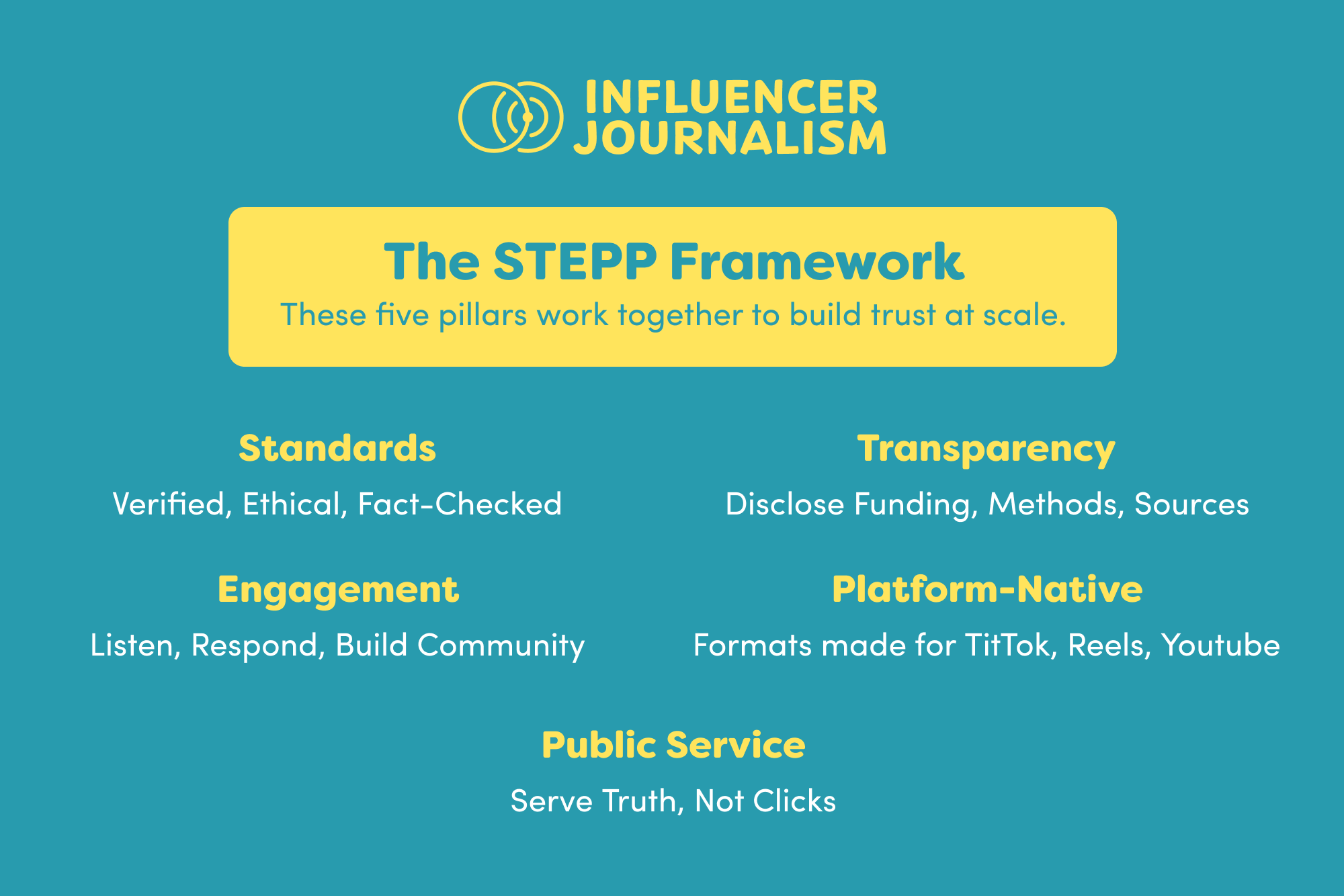
The STEPP Framework provides that map. It offers a structured approach to navigating this emerging space while protecting what matters most: the public’s trust in journalism.
The numbers tell an urgent story. According to Pew Research Center, nearly 40% of adults under 30 now regularly get their news from influencers on social media. Meanwhile, Gallup reports that just 28% of Americans express confidence in traditional media to report the news fully, accurately, and fairly, a historic low.
These trends are not coincidental. Young audiences are not abandoning news; they are finding it in different places, through different voices, in different formats. The question facing newsroom leaders is not whether to engage with this reality, but how to do so responsibly.
The risks of unstructured creator partnerships are significant. Without clear guidelines, newsrooms may partner with creators whose content undermines editorial credibility. Creators may feel constrained by newsroom demands that strip their work of authenticity. Audiences may lose trust in both parties when the partnership feels inauthentic or transactional.
Yet the opportunity is equally significant. Creator partnerships can extend the reach of important journalism to communities traditional distribution channels cannot access. They can rebuild trust with audiences who have disengaged from legacy media. They can bring new voices and perspectives into the news ecosystem while providing sustainable revenue streams for both newsrooms and creators.
As the American Press Institute has documented through its Influencer Learning Cohorts, newsrooms that approach these partnerships thoughtfully are discovering “blueprints for how local journalism can rebuild relationships, expand its reach in meaningful ways and strengthen its role in public life.”
What has been missing is a shared vocabulary and structure for making these partnerships work, one that honors both journalistic values and creator culture. That is what STEPP provides.
The STEPP Framework did not emerge from academic theory. It was forged in the field through experiments that worked, partnerships that failed, and countless conversations with editors, creators, and audiences about what makes collaborations succeed or stumble.
Through this work, patterns emerged. Successful partnerships shared certain characteristics; failed ones lacked them. Over time, these observations crystallized into five principles that I found myself returning to again and again: Standards, Transparency, Engagement, Platform-Native content, and Public Service.
Through Influencer Journalism, I have tested and refined STEPP with newsrooms ranging from nonprofit startups to major metropolitan and international dailies.
What follows is the framework in its complete form: each pillar explained, with concrete examples from real partnerships and practical guidance for implementation.
Standards form the foundation of any credible creator-newsroom partnership. This pillar addresses the non-negotiable principles that protect editorial integrity while respecting creator authenticity.
What Standards means in practice:
Accuracy and verification: Any factual claims in collaborative content must meet newsroom standards for verification. This does not mean creators cannot offer opinions or commentary, but factual assertions require the same rigor applied to traditional journalism.
Corrections and accountability: Partnerships should include clear processes for addressing errors. If a collaborative post contains inaccurate information, how will it be corrected? Who is responsible for monitoring and flagging issues?
Values alignment: Before entering partnerships, newsrooms should assess whether a creator’s history and content align with organizational values. This includes reviewing past content for misinformation, conspiracy theories, or conduct that could compromise credibility.
Independence from commercial influence: Standards for disclosing sponsored content and maintaining separation between editorial and commercial interests should be established upfront.
Example from the field: When PublicSource partnered with Pittsburgh-based creators through API’s Influencer Learning Cohort, the newsroom invested significant time in vetting potential partners. As documented in their case study, they assessed creators for “ethical alignment," examining whether influencers “adhere to values that align with your newsroom’s journalistic integrity” before pursuing collaborations.
Transparency is about making the nature of the partnership visible to audiences. In an era of declining trust, audiences deserve to know when content involves collaboration between newsrooms and creators—and what the terms of that collaboration are.
What Transparency means in practice:
Clear disclosure: When content is the result of a newsroom-creator partnership, that relationship should be disclosed in a way audiences can easily understand. This goes beyond FTC requirements for sponsored content to include editorial collaborations.
Financial transparency: If creators are compensated for their work, the nature of that compensation should be acknowledged. This does not necessarily mean disclosing specific amounts, but audiences should understand whether a creator has a financial relationship with the newsroom.
Process transparency: When appropriate, share how the collaboration works. What role did each party play? What editorial oversight exists? This demystifies the partnership and builds trust.
Honest limitations: Be clear about what content is and is not. A creator’s perspective piece is not the same as an investigative report. Opinion should be labeled as such.
Example from the field: THE CITY in New York has partnered with The Pigeon Post on video explainers about civic issues. Their collaboration is clearly labeled, with both organizations’ branding visible and the nature of the partnership explained to audiences. This transparency allows viewers to understand the source of the content while benefiting from the reach of both parties.
Engagement recognizes that creator partnerships are fundamentally about relationship—with creators, with their audiences, and with communities. The most successful partnerships create ongoing connections, not one-off transactions.
What Engagement means in practice:
Relational over transactional: Approach creators as partners, not vendors. Invest time in understanding their work, their audience, and their creative process before discussing specific collaborations.
Community listening: Use partnerships to learn about communities you may not be reaching through traditional channels. Creators often have deep insight into audience needs, concerns, and information gaps.
Two-way value: Successful partnerships benefit both parties. What can the newsroom offer the creator beyond compensation? Access to sources? Editorial support? Credibility enhancement? The partnership should feel mutually enriching.
Long-term orientation: Build partnerships designed to deepen over time. One-off campaigns rarely build the trust needed to meaningfully extend journalism’s reach.
Example from the field: PublicSource’s approach exemplifies engagement-first thinking. As they describe in their case study: “We prioritized outreach for learning first, not just deals. We scheduled discovery calls to introduce Public Source, understand the creator’s work and audience, and talk about overlap. Partnerships are seen as a result, not a precondition.” This investment in relationship produced eight new conversations, multiple partnerships, and doubled their Instagram following in 18 months.
Platform-Native content acknowledges that different platforms have different cultures, formats, and expectations. Content that works on Instagram will not necessarily work on TikTok, YouTube, or a newsroom’s website. Successful partnerships leverage the creator’s platform expertise.
What Platform-Native means in practice:
Format flexibility: A story that works as a 1,500-word article may need to become a 60-second video, a carousel of images, or an interactive story for platform distribution. Be willing to adapt format while maintaining substance.
Creator voice: Audiences follow creators because of their unique voice and style. Partnerships that strip creators of their authenticity defeat the purpose of collaboration. Allow creators the freedom to translate journalism into their authentic voice.
Algorithm awareness: Creators understand platform algorithms in ways many newsrooms do not. Trust their expertise on timing, hooks, hashtags, and other elements that affect content distribution.
Native distribution: Rather than always driving audiences to the newsroom’s properties, consider letting content live where audiences already are. The goal is reaching people with important information, not necessarily converting them to website traffic.
Example from the field: Through API’s Influencer Learning Cohort, the Houston Chronicle worked with food influencers to bring new energy to dining coverage. Rather than asking creators to simply promote Chronicle content, they developed native collaborations that leveraged each creator’s unique relationship with their audience and platform expertise.
Public Service anchors the entire framework in journalism’s core purpose. Creator partnerships should ultimately serve the public interest: informing communities, promoting civic engagement, and strengthening democratic participation. Without this anchor, partnerships risk becoming merely marketing exercises.
What Public Service means in practice:
Community benefit: Every partnership should have a clear answer to the question: How does this serve the public? If the answer is only “it extends our reach” or “it builds our brand,” the partnership may be missing its primary purpose.
Civic information: Prioritize partnerships that help communities access information they need to participate in civic life—voting, local government, public health, community resources.
Underserved audiences: Use partnerships to reach communities that traditional journalism has historically underserved. Creators often have trust and reach in communities where legacy media does not.
Impact orientation: Measure success not just by views or engagement, but by public impact. Did the partnership help people take action? Access resources? Understand an issue? Vote?
Example from the field: Factchequeado, a nonpartisan nonprofit, worked with Latino creators through API’s cohort to develop training that helps influencers recognize and counter Spanish-language disinformation. This partnership serves a clear public purpose: protecting vulnerable communities from harmful misinformation while building creator capacity for responsible information-sharing.
Before launching creator partnerships, newsrooms should honestly assess their readiness across each STEPP dimension. The following questions can guide that assessment:
Standards Assessment:
• Do we have documented standards for creator partnerships, or are we making decisions ad hoc?
• Have we defined what values alignment means for potential creator partners?
• Do we have a vetting process that multiple team members follow consistently?
• Have we established correction and accountability processes for collaborative content?
Transparency Assessment:
• Do our audiences know when content involves creator partnerships?
• Are we clear about the financial nature of our creator relationships?
• Do we label opinion and perspective content appropriately?
Engagement Assessment:
• Are we approaching creators as partners or as distribution channels?
• Do we invest in relationship-building before asking for specific deliverables?
• What value do we offer creators beyond compensation?
• Are we building for long-term relationships or one-off campaigns?
Platform-Native Assessment:
• Do we allow creators flexibility in format and presentation?
• Are we respecting creator voice and authenticity?
• Do we trust creators’ platform expertise?
Public Service Assessment:
• Can we articulate how each partnership serves the public interest?
• Are we prioritizing civic information and underserved communities?
• Are we measuring impact beyond reach and engagement metrics?
Through consulting work with newsrooms across the globe, I have observed patterns in how creator partnerships go wrong and how applying STEPP principles can prevent these failures.
Mistake 1: Treating creators as distribution channels rather than partners
Many newsrooms approach creators with a simple proposition: share our content with your audience. This transactional approach ignores what makes creators valuable which is their authentic voice, their community relationships, their creative approach. It also provides little value to the creator. STEPP’s Engagement pillar reframes partnerships as genuinely collaborative, with two-way value exchange and investment in relationship.
Mistake 2: Expecting creators to conform to newsroom style
When newsrooms try to impose their voice, format, and style on creator content, the result often feels inauthentic to audiences, defeating the purpose of the partnership. The Platform-Native pillar reminds newsrooms that creators succeed because of their unique voice and approach. Respecting that authenticity while maintaining standards is the creative challenge at the heart of effective partnerships.
Mistake 3: Skipping due diligence on creator alignment
In the rush to build partnerships, some newsrooms partner with creators whose past content or values conflict with journalistic standards. This can lead to credibility damage for both parties. STEPP’s Standards pillar emphasizes the importance of thorough vetting before partnerships begin—reviewing content history, assessing ethical alignment, and establishing clear expectations.
Mistake 4: Hiding or downplaying the partnership
Some newsrooms worry that disclosure will make partnerships seem less authentic. In reality, transparency builds trust. Audiences are increasingly sophisticated about media partnerships; attempting to hide them erodes credibility. The Transparency pillar makes clear that disclosure should be embraced, not avoided.
Mistake 5: Measuring only reach and engagement
It is tempting to evaluate partnerships purely by numbers—views, likes, shares, follower growth. But these metrics can miss what matters most. Did the partnership help people access important information? Did it build trust with underserved communities? Did it serve the public interest? The Public Service pillar anchors evaluation in impact, not just reach.
Mistake 6: One-off campaigns instead of sustained relationships
Single collaborations rarely build the trust needed to meaningfully extend journalism’s reach. The most impactful partnerships develop over time, with each collaboration building on the last. STEPP’s Engagement pillar emphasizes long-term orientation and relationship investment.
For newsrooms ready to apply STEPP, the following implementation roadmap offers a practical starting point:
Phase 1: Foundation (Weeks 1-4)
• Convene key stakeholders: editorial leadership, audience development, social media, and legal.
• Document existing standards and identify gaps.
• Define what values alignment means for your organization.
• Establish disclosure and transparency protocols.
Phase 2: Landscape Mapping (Weeks 5-8)
• Identify local creators across priority platforms.
• Build a database with consistent vetting criteria.
• Have multiple team members follow potential partners to observe content over time.
• Consider working with consultants like Influencer Journalism to accelerate this process.
Phase 3: Relationship Building (Weeks 9-12)
• Initiate discovery conversations with priority creators.
• Focus on learning about their work and audience before proposing specific collaborations.
• Identify mutual value opportunities.
Phase 4: Pilot Partnerships (Weeks 13-16)
• Launch one or two pilot collaborations with high-alignment creators.
• Document what works and what does not.
• Gather feedback from creators and audiences.
Phase 5: Iteration and Scale (Ongoing)
• Refine approach based on pilot learnings.
• Expand partnerships with proven partners.
• Continue landscape mapping to identify new opportunities.
• Share learnings with the broader journalism community.
The creator economy is not a threat to journalism, it is an opportunity. An opportunity to reach audiences who have disengaged from traditional news. An opportunity to rebuild trust with communities who feel unseen by legacy media. An opportunity to strengthen journalism’s role in democratic life.
But seizing this opportunity requires intentionality. Newsrooms cannot simply throw money at influencers and hope for results. They need frameworks that protect editorial integrity while embracing the authentic engagement that defines creator culture.
STEPP provides that framework. By grounding partnerships in Standards, Transparency, Engagement, Platform-Native content, and Public Service, newsrooms can navigate this emerging space with confidence building collaborations that serve both journalism’s mission and audiences’ evolving needs.
The newsrooms succeeding in this space like PublicSource, THE CITY, the Houston Chronicle, Factchequeado, and others are proving that responsible creator partnerships are possible. Their experiments, documented through the American Press Institute on Better News, offer concrete models for others to follow.
The question is no longer whether journalism and the creator economy will converge. They already have. The question is whether that convergence will strengthen journalism’s public service mission or dilute it. STEPP offers a path toward the former.

New research from FT Strategies and Knight Lab confirms what we’ve been saying: Next gen audiences are hungry for news. The problem isn’t demand—it’s delivery

Introducing the STEPP Framework, MLK50's creator-in-residence experiment, and why disclosure matters more than you think

Without rigorous, clear disclosure in every partnership, both the newsroom's reputation and the creator's authenticity are at stake.