
Your Next Creator Partner Might Be a Professor
The latest High Country News collab proves the best creator partnerships aren't where you think
The latest High Country News collab proves the best creator partnerships aren't where you think

375 journalists lost their jobs at The Washington Post. The answer isn't solo vs. institutional but what we build between the two.
New research from FT Strategies and Knight Lab breaks the myth — plus why the "E" in STEPP matters more than ever, and what we're up to at the Saudi Media Forum.
New research from FT Strategies and Knight Lab confirms what we’ve been saying: Next gen audiences are hungry for news. The problem isn’t demand—it’s delivery

There’s a narrative that’s been floating around newsroom leadership for years: young people don’t care about news. They’re checked out. They’d rather watch TikTok dances than read about city council meetings. It’s a convenient story, because it lets legacy news organizations off the hook for failing to evolve.
New research from Next Gen News 2, a joint project from FT Strategies and Northwestern University’s Knight Lab, supported by the Google News Initiative, puts that narrative to rest. Their findings, drawn from 5,000 survey respondents and 84 diary study participants across five countries, paint a very different picture: more than half of next gen news consumers engage with news at least daily, and a third do so multiple times per day. When asked if they “value news for personal and professional development,” 65% agreed or strongly agreed.
The audience is there. They’re paying attention. But the report also confirms something critical: these consumers feel overwhelmed by the amount of news they encounter, and they’re making deliberate choices about who they trust to help them navigate it. Trust, according to the research, “is less about institutional brands and more about a parasocial relationship with the news producer.”
That finding alone should reshape how every newsroom thinks about distribution. And it’s the exact space where creator partnerships fit.
The report introduces an expanded “Modes of Engagement” framework that maps how next gen consumers actually interact with news. It breaks the process into two phases: discovery (how people find news) and consumption (what they do with it once they find it).
On the discovery side, the researchers identified three distinct modes: Scroll (passively encountering news in algorithmic feeds), Seek (actively searching for specific information), and Subscribe (receiving news from trusted sources through newsletters, podcasts, or habitual visits). On the consumption side, three more: Substantiate (fact-checking and verifying), Study (deep-diving into a topic), and Sensemake (exploring different perspectives to form opinions). And running through all of it is Socialize—the bi-directional sharing of news with people they trust.
What’s most striking is what the researchers found about sifting—the process of filtering news from noise. It is not passive. Younger audiences are actively curating their information ecosystems. They’re intentionally molding their feeds, managing algorithms through deliberate behaviors like scroll speed, selective engagement, and strategic “liking.” They’re doing the work. The question is whether your newsroom’s content makes the cut.
One of the most important findings in the report is that the news producers successfully reaching next gen audiences aren’t legacy outlets. They’re what the researchers call “emerging news producers”—content developers with non-legacy entities who are “perceived as more trusted and more relatable than those in legacy newsrooms.”
Read that again. More trusted. More relatable. Not because they’re doing better journalism necessarily, but because they’ve figured out how to meet audiences in the modes where they actually operate.
The report profiles producers like Macy Gilliam at Morning Brew, whose “Out There” series embeds her in the field learning about jobs and industries. It highlights Local News International’s Dave Jorgenson, who covers global news in 40-second comedic sketches. It examines The Daily Aus, which leads with facts in clean Instagram carousels. These aren’t journalists operating in opposition to newsrooms—they’re creators who’ve built the trust and format fluency that newsrooms need.
This is exactly why newsroom-creator partnerships aren’t a nice-to-have. They’re the mechanism through which legacy news organizations can insert themselves into every mode of engagement this report describes.
Consider how this maps:
Scroll: The report emphasizes that leading producers “win the first two seconds” and develop “repeatable storytelling templates.” Creators already know how to do this on their home platforms. A newsroom partnering with a TikTok creator who covers local politics doesn’t need to teach them how to hook an audience as the creator already has that skill. What the newsroom brings is editorial rigor and sourcing. What the creator brings is format fluency and audience trust. That’s the partnership.
Subscribe: The researchers found that subscription-based discovery is built on habit and trust. Creators with loyal audiences—podcast hosts, newsletter writers, YouTube educators—already have this. When a newsroom partners with a creator whose audience has opted in to receive their content, you’re not fighting the algorithm. You’re delivered directly to people who chose to be there.
Substantiate: Next gen consumers actively verify what they see. The report highlights producers who “show their work” by providing primary sources, transparent methodologies, and annotated evidence. Newsrooms have always done this work. Partnering with creators gives that verification process a distribution channel that actually reaches the audiences doing the checking.
Study: The report directly challenges the idea that young people don’t consume long-form content. They do, when it’s framed with clear learning goals, built progressively, and brought to life with on-the-ground reporting. YouTube creators like Mohak Mangal and HowTown are building 15-to-30-minute explainers that audiences watch and rewatch. Newsrooms sitting on deep investigative work could reach entirely new audiences by partnering with creators who specialize in this mode.
Sensemake: This is where transparency of bias and open conversation matter most. The report highlights producers like Ezra Klein and The Rest is Politics, who clearly disclose their viewpoints and create space for audiences to form their own opinions. Creators who are transparent about their perspectives and newsrooms that are honest about theirs build the kind of trust that this generation demands.
Socialize: Perhaps the most underrated finding: socialization is bi-directional. People share news because people they trust share news with them. Creator-produced content is inherently more shareable, it’s designed for the platforms where sharing happens. When a newsroom’s reporting travels through a creator’s audience, it doesn’t just reach more people. It reaches them through a trusted intermediary, which the research shows is how next gen consumers prefer to receive news in the first place.
One of the report’s most significant findings is what it calls “reverse journalism”—the idea that successful emerging producers start from distribution rather than treating it as an afterthought. Instead of creating a story and then figuring out where to put it, they begin with the platform, the format, and the audience behavior, then work backward to the story.
The researchers frame it clearly: “Distribution, rather than an afterthought, now drives creativity.” And from that, “one imperative emerges: To succeed, producers must invest heavily in new distribution capabilities. The ability to reach and engage audiences is no longer a downstream function of good journalism; it is a core creative and strategic competency.”
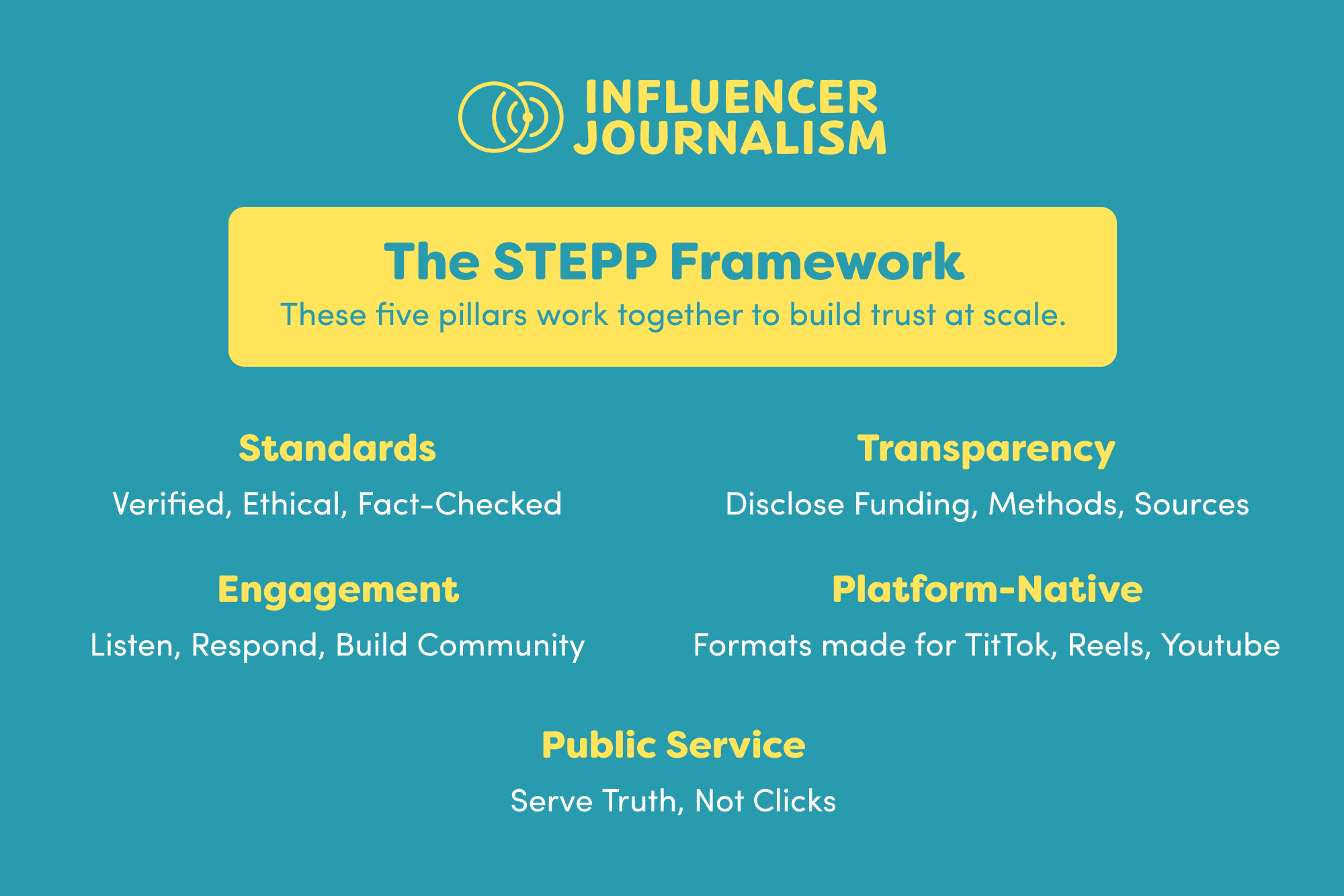
This is essentially the argument we’ve been making at Influencer Journalism since we started. Creator partnerships are not a marketing tactic bolted onto existing journalism. They’re a distribution strategy that should inform how stories are conceived, produced, and delivered. The STEPP Framework we developed exists precisely because this work requires structure Standards, Transparency, Engagement, Platform-Native content, and Public Service aren’t just guardrails, they’re the operating system for making these partnerships produce real journalism.
We’ve seen these dynamics play out firsthand. When High Country News partnered with creators to reach a new generation of readers, the approach mapped directly onto the modes this report describes. A 50-year-old publication known for deep environmental reporting in the American West had been relying on direct mail to reach its audience. Through our Verified Storytellers program, we matched them with creators who already had trusted relationships with outdoor, environmental, and Western communities on social platforms.
The creators didn’t replace High Country News’s journalism. They gave it new pathways into the Scroll and Socialize modes where next gen audiences already operate. The newsroom’s reporting got surfaced to audiences who would never have encountered it through a subscription page or a Google search—audiences who were already actively curating their feeds around exactly the topics High Country News covers.
That’s the gap this research quantifies. The audience exists. The interest exists. What’s missing is the connective tissue between the journalism being produced and the places where these audiences are making their information choices.
The report also flags something that should make newsroom leaders pay closer attention: AI is increasingly part of how next gen consumers find and process news. Some diary study participants cited large language model chatbots as a news source. While adoption rates vary by country, the direction is clear here as audiences are beginning to outsource their information synthesis to tools that may or may not surface your journalism.
This makes human-to-human trust even more valuable. When audiences are navigating a landscape that includes AI-generated summaries, algorithmic feeds, and infinite content, the producers who break through are the ones with authentic personal presence. Creators have that. And when creators are partnered with newsrooms that provide editorial standards and accountability, the combination is more resilient to AI disruption than either side alone.
The first Next Gen News report, published in 2024, found that “young people have a complex and evolving relationship with the news. They simultaneously understand the value that news can play in their lives but are often disinterested or frustrated with how it’s being delivered to them.” The 2025 follow-up deepens it. These audiences aren’t waiting around for newsrooms to figure it out. They’re actively building their own information environments, choosing the producers they trust, and shaping the algorithms that serve them content.
The newsrooms that will reach them are the ones that show up where they already are, through people they already trust, in formats that respect how they actually consume information.

Introducing the STEPP Framework, MLK50's creator-in-residence experiment, and why disclosure matters more than you think

Without rigorous, clear disclosure in every partnership, both the newsroom's reputation and the creator's authenticity are at stake.

We offer a structured approach to navigating this emerging space while protecting what matters most: the public’s trust in journalism.