A 29-year-old YouTuber now matches France’s biggest network in audience trust. TF1 is partnering with him — and creators like him — to lend the newsroom some of that credibility. Early results suggest some of these alliances aren’t working
A newsroom with no dedicated social staff used the cohort to assemble a cross-team working group and plan its first original creator collaboration, a series on the city's beloved sausage culture.
For a nonpartisan newsroom covering politics, the toughest part of a creator partnership came before any outreach: deciding which creators it could work with without putting its credibility at risk.
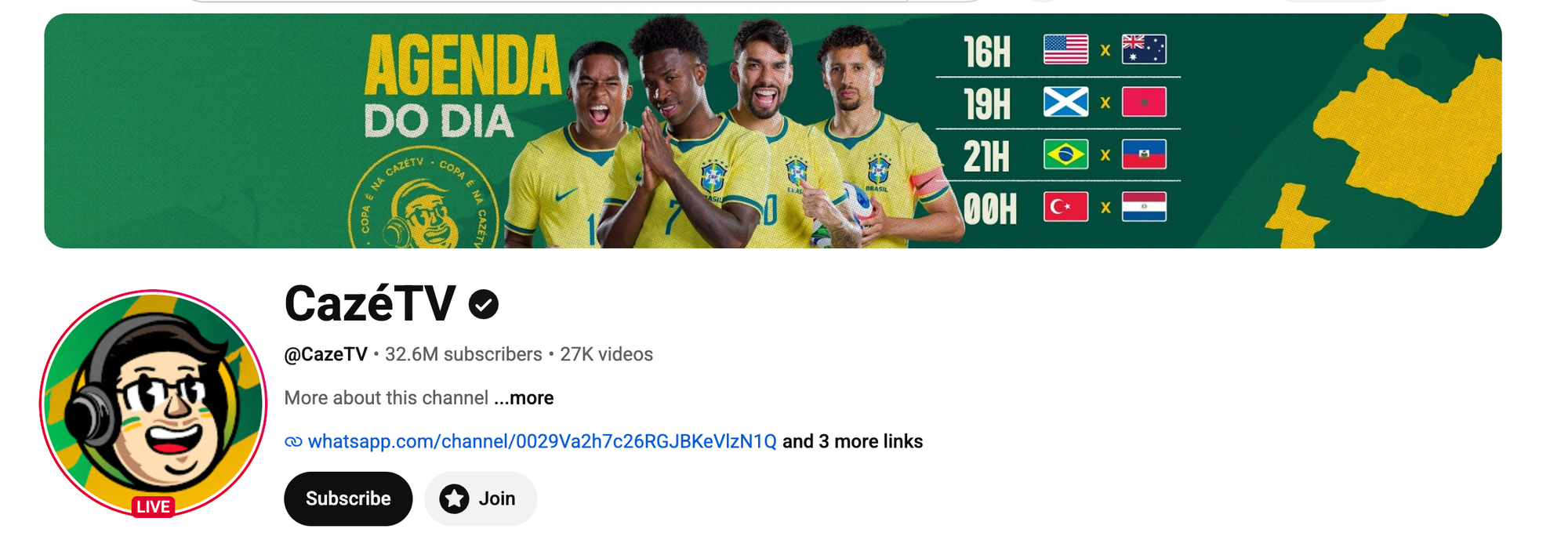
The 2026 FIFA Men’s World Cup is testing the United States’ appetite for soccer. Further south, Brazil is already ahead, not just in how to love the game, but how to watch it. For millions of Brazilian fans, the tournament will not come through a television network. It will come through a YouTuber. CazéTV, built by journalism school dropout Casimiro Miguel (aka Cazé) in partnership with LiveMode, FIFA's commercial agency in South America, will stream all 104 World Cup matches to Brazilian audiences.
On June 13, Brazil’s opening match against Morocco drew 12.2 million simultaneous viewers on CazéTV — the largest live audience in YouTube history, surpassing the Indian space agency’s 2023 moon landing broadcast. CazéTV now holds six of the ten largest YouTube live audiences ever recorded.
For decades, watching soccer in Brazil meant watching Globo. The network controlled the rights, the cameras, and the narrative. Younger Brazilians had no real alternative, until Cazé built one.
The channel now has 32.5 million YouTube subscribers and 17.2 million on Instagram. Its coverage blends institutional access with humor, memes, and live audience participation that verges on locker room banter. FIFA calls it “the top digital sports platform in Brazil.” The deal cuts into Grupo Globo’s turf, which holds rights to Brazil’s matches and the final, but not all 104 games.
Influencer Journalism spent months attempting to reach LiveMode and Casimiro Miguel, but a packed sports calendar left no window to respond. To understand what CazéTV represents, and what it doesn't, we turned to Nicolas Duprat, a Brazilian sports media researcher who has spent years studying the platform, and to Gabriela Nunes, a Brazilian soccer fan and CazéTV viewer.The MPV: Casimiro Miguel aka Cazé
His self-deprecating humor and directness built something traditional broadcasters couldn’t manufacture: trust. “Unlike traditional media, where people are careful to hide their allegiances, he always made clear he was a Vasco fan,” says Duprat.
A 2021 Brazilian law giving clubs the right to sell their own home game streaming rights cracked open the market long controlled by Globo. Soccer club Atlético Paranaense was the first to act, selling its rights directly to Casimiro. Cazé put the games behind a paywall on Twitch and charged $1.99 for access to Athletico Paranaense games. Behind the deal was LiveMode, a sports rights company whose founders had built Esporte Interativo, the network where Cazé got his start.
Then came 2022. FIFA wanted to launch its own streaming platform, FIFA Plus. LiveMode warned them the launch would demand massive investment with no guarantee of success. “We told them the chance of it going wrong was 100 percent,” said Edgar Diniz, a LiveMode partner, in an interview with Globo Esporte. Their counter-proposal: stream the World Cup through Casimiro, free, on YouTube. Even Casimiro didn’t see it coming. “Man, it seemed really bizarre. You were there doing little games here and there — and now you're going to broadcast the World Cup. What the hell,” recalled Cazé in a broadcast.
That test became CazéTV.
CazéTV’s take off
Sports fans weren’t just watching the game. They were watching Cazé watch it. “I prefer watching on CazéTV because of the style,” Gabriela Nunes, a Brazilian soccer fan, told Influencer Journalism. “I have fun.” Living abroad, she couldn’t access games locked behind Globo’s paywall or unavailable in her region. CazéTV was her go-to alternative.
Cazé was also pulling in people who had never watched the World Cup. “We thought all Brazilians watch the World Cup, but that was not true,” said Sérgio Lopes, LiveMode co-founder, in an interview with Sports Pro. “There was a digital-first audience of young people between 18 and 44, with a real core between 18 and 34. They wake up and look at social media and YouTube to see what’s going on, they do not turn on the TV. And we got these guys to connect and watch the World Cup,” noted Lopes.
“There was a digital-first audience of young people between 18 and 44, with a real core between 18 and 34. They wake up and look at social media and YouTube to see what’s going on, they do not turn on the TV. And we got these guys to connect and watch the World Cup" — Sérgio Lopes, LiveMode co-founder
The Youtuber became a phenomenon. One viewer commented on one of his videos: “I cannot believe that I'm another victim of 'who is this Casimiro,' and just like that, it's been two hours.”
During the 2022 tournament, CazéTV drew 6.9 million concurrent viewers for Brazil vs. Croatia — one of the largest live audiences in YouTube history. Duprat credits the tone: “jokes, strong language, nothing you’d see on conventional television.” But the formula wasn’t purely chaotic. CazéTV paired comedian influencers with recognized Globo journalists like Fernanda Gentil and former athletes like Juninho Pernambucano. “That,” says Duprat, “was their first great move.”
The disruption shook Globo into launching GE TV. Globo won on raw viewers during a Flamengo vs. PSG match, but CazéTV generated nearly 16 million Instagram interactions to GE TV's 1.8 million. Casimiro had something broadcast TV was still chasing: community. Its fans weren’t just watching: they were talking, sharing, and returning. That engagement translated into commercial power. CazéTV generated over $160,000 in a single month from YouTube views alone, backed by major sponsors including Stellantis, Unilever, and McDonald’s. Before going free on major events, CazéTV tested low-cost subscription models, charging roughly $1.50 a month on Twitch and as little as $0.40 on YouTube for access to Athletico Paranaense games.
In 2023, CazéTV became the first platform to stream all Women’s World Cup games free and publicly in Brazil, no subscription, no paywall. It secured 11 confirmed sponsors for the 2026 World Cup, outpacing Globo's four, with names including Ambev, Coca-Cola, Itaú, and Mercado Livre. Now, live broadcasts remain free, CazéTV offers a $0.99 monthly YouTube membership unlocks perks like exclusive chats, custom emoji, and loyalty badges.
The reach extended beyond soccer. Sports Brazilians had never followed like curling, skiing, alpine events suddenly found audiences during the Winter Olympics. Earlier this year, 317,000 people tuned into Twitch to watch Casimiro cover sports, react to a Who Wants to Be a Millionaire–style game, and read the chat in real time — for ten straight hours. This long-form, unscripted broadcast, became one of CazéTV’s signatures.
New player, but a familiar playbook
CazéTV has made soccer more democratic to fans priced out of stadiums and paywalled broadcasts. “The fan who can no longer afford a seat, where does he watch? At home. Someone had to reach him there,” notes Duprat. But accessibility is not the same as inclusion. “It kills me to read people saying: my grandfather tried to watch CazéTV and couldn't figure it out. That's terrible. That's really bad,” Casimiro acknowledged.
Technology adds another layer. In live sports, every second counts. “The internet delay is a problem. We suffer with it. It's a huge issue,” Casimiro has said on his broadcasts.
And all that democratization opened the door to yet another tension: fragmentation. More platforms mean more access, but also more confusion. “Rights are spread across four, five, or six platforms, making it hard for fans to know where to watch,” says Edgar Diniz of LiveMode in an interview for GE.
However disrupted, the channel remains a product of its culture.
CazéTV was born on Twitch, in a niche environment where humor, irreverence and strong language were part of the culture. But when millions tune in, families watch together, children are in the room. That is when audiences demand the same accountability from online channels that they expect from traditional television.
The live chat, one of CazéTV’s most identitary features, became the first sign of that contradiction. During the 2023 Women’s World Cup, with roughly two million people watching, misogynistic comments became unmanageable. Unlike on Twitch, where moderators could quickly remove users, Duprat said YouTube offered fewer tools to control abusive behavior in real time. “There came a point where it was, ‘We have to close it,’” he recalled. Duprat believes it may have been the first time in CazéTV’s history that the live chat was shut down. In a statement at the time, CazéTV said the measure was taken after some viewers used the broadcast’s visibility to spread discriminatory comments, and pledged to strengthen moderation for subsequent games.
But the gender problem goes deeper at CazéTV. During the Club World Cup, Casimiro joked on air about comparing his anatomy to that of a Brazilian adult film star. He never apologized. “When the man who gives his name to CazéTV thinks it’s reasonable to make that joke,” said journalist Milly Lacombe on Instagram, “the future of TV is going to be equally sexist and misogynistic.” In the same post, her colleague Alicia Klein put it in structural terms: “We’re not talking about a misogynist audience. We’re talking about employers who institutionalized misogyny.”
Duprat’s research credits CazéTV with expanding visibility of women’s football in 2023 but says it did not translate into equity. Misogyny in chat spaces and the underrepresentation of Black women remained structural problems. “It's a deep remnant of Brazilian football’s structure: masculine and heteronormative,” says Duprat. Changes came only after sponsors, LiveMode, and FIFA pushed back.
Free content isn’t free to make. “Yes, there are a lot of ads, because it's free. Sometimes it gets tiring. People complain, and they're right, it's annoying. But you have to pay for it somehow,” Cazé argued in a broadcast.
But here’s where things get complicated: on traditional television, advertising is clearly separated from reporting; on CazéTV, those lines blur. When Casimiro sells a betting coupon live to millions of young viewers with no risk warning, he is simultaneously the journalist, the host, and the advertiser.
What he advertises opens another layer of criticism. In 2024, Brazilians spent roughly $46 billion on betting platforms, with 1.8 million falling into default, sports betting has since become the leading cause of household debt in the country. The issue was addressed in a Senate public hearing, but CazéTV was not mentioned. So far, the loudest critics have been on Reddit, while the mainstream conversation has barely started.
Many goals, some misses
For broadcasters watching from abroad, the lesson isn’t simply that a YouTuber beat a network. It’s that a generation of fans was never unreachable: they were just never spoken to in their own language.
What CazéTV hasn’t shown is that disrupting distribution automatically disrupts culture. The betting sponsors followed the audience. So did the old hierarchies. That gap, between who gets to watch and who gets to be heard, remains the unfinished story.
“CazéTV is a landmark case, the largest global case of an influencer reaching this level,” says Duprat. “But you can’t get there alone.” And getting there, he adds, comes with a minimum expectation: “Ethics. A defense of human rights.”
Brazilian-American journalist & strategist with 15 years of experience using storytelling to build community in news and tech. She’s worked in nonprofit and legacy media & tech startups (CalMatters, O Globo, Hive). Ana is on NAHJ LGBTQIA+ Task Force.
A 29-year-old YouTuber now matches France’s biggest network in audience trust. TF1 is partnering with him — and creators like him — to lend the newsroom some of that credibility. Early results suggest some of these alliances aren’t working
A newsroom with no dedicated social staff used the cohort to assemble a cross-team working group and plan its first original creator collaboration, a series on the city's beloved sausage culture.
For a nonpartisan newsroom covering politics, the toughest part of a creator partnership came before any outreach: deciding which creators it could work with without putting its credibility at risk.