A 29-year-old YouTuber now matches France’s biggest network in audience trust. TF1 is partnering with him — and creators like him — to lend the newsroom some of that credibility. Early results suggest some of these alliances aren’t working
A newsroom with no dedicated social staff used the cohort to assemble a cross-team working group and plan its first original creator collaboration, a series on the city's beloved sausage culture.
For a nonpartisan newsroom covering politics, the toughest part of a creator partnership came before any outreach: deciding which creators it could work with without putting its credibility at risk.
A lot of newsrooms have reached out to me this spring asking some version of the same question, which is how do they find the right creator to partner with. I understand why people ask it, because the pressure to figure this out is real right now. TheReuters Institute's 2026 Journalism Trends report found that 50% of publishers plan to partner with creators for distribution this year, 31% are considering hiring them directly, and 76% will push their own journalists to behave more like creators. Editor & Publisher called creator partnerships a move from "novelty to necessity" this year.
But I think it's the wrong question, and I'll tell you what I've been telling the newsrooms who email me, which is the same thing I just told the five newsrooms in ourCatchLight Creator Collaboration Cohort when we sat down for Session 2 a few weeks ago. Most newsrooms start their creator search by scrolling. They make lists of creators they admire and then try to figure out what to do with them. That's how marketing teams work, and it's not how journalism works. When you start with the creator instead of the goal, you end up bending the partnership to fit the person, which means you're building a project around their audience and their format and their availability rather than around what your newsroom actually needs to accomplish.
The framework I walk newsrooms through is pretty simple, and it has three steps in a specific order: Goal, then Model, then Creator. The goal points to the model, and the model narrows which creator actually fits. Most newsrooms skip the first two steps entirely, which is why so many partnerships look great on paper and then quietly fall apart six weeks in.
Step One: Start With the Goal
There are really four high-level goals we've found that a newsroom-creator partnership can serve, and most partnerships have one primary goal and one secondary. If you're trying to do all four at once, the partnership is going to struggle.
The first is reach, which means you want to grow into communities you haven't been able to reach through your own channels. This is usually the first goal newsrooms identify, and it's the one most people default to even when it isn't actually their real goal. Reach is about new audiences, new platforms, and new geographies that your existing distribution can't get you to.
The second is trust, which is harder than reach because it means you want to build credibility with a community where you have none, or where you've lost it. Trust isn't a metric you can buy, and you can't shortcut your way to it with a sponsored post. If trust is your goal, you're committing to something longer and more sustained than a one-off campaign, and you need to know that going in.
The third is access, where you want closer proximity to a story or a source or a community, and the creator's relationships open doors that your newsroom can't open on its own. Access is one of the most underrated goals in this work, because it's the one that actually changes the journalism rather than just the distribution. When a creator has proximity that your reporters don't, the partnership can produce stories you couldn't have produced alone.
The fourth is format, which is when you want to learn how to tell stories natively on platforms your newsroom doesn't own yet. In this case, the creator isn't just distributing your work but teaching you how the format actually functions. If your newsroom is trying to get fluent in TikTok or YouTube or vertical video, the smartest move is partnering with someone who already speaks the language rather than trying to learn it from scratch.
Pick one as primary and be honest with yourself about which one is really driving the partnership. You can have a secondary goal too, but if you can't name the primary one in a single sentence, you're not ready to move to step two.
Step Two: Let the Goal Point to the Model
Once you know your goal, the collaboration model gets clearer, and this is where a lot of the confusion in this space gets cleared up. There are four models we work with, and each one fits different goals.
Sponsored content is the entry-level option, and it's lower-risk because it's time-bound and transactional. The creator produces something specific for your newsroom, you pay them, and the engagement ends when the deliverable is delivered. This model fits reach goals well because it lets both sides test the relationship without a major commitment.
Co-creation is a deeper collaboration where the creator and the newsroom build something together, whether that's a reporting project, a video series, or a story package. The creator isn't just amplifying your work but actively shaping it. This model fits access goals and format goals, because both require real collaborative time rather than a transactional engagement.
Ambassador is a sustained representation model where the creator becomes an ongoing voice associated with your newsroom over a longer period. This is the model that fits trust goals, because trust is built through repetition and consistency rather than one-off appearances. An ambassador relationship signals to the community that this isn't a one-time marketing play.
Fellowship is the most structured and the highest investment, and it's typically a program where the creator is embedded with your newsroom for a defined period with funding, mentorship, and editorial support. Fellowships fit format goals especially well, because they create the time and structure for genuine craft transfer in both directions.
The mapping isn't rigid, but the pattern is usually this: reach goals point to sponsored content, trust goals point to ambassador, access goals point to co-creation, and format goals point to co-creation or fellowship.
Step Three: Now You Can Pick the Creator
Once you know the goal and the model, the creator search gets a lot sharper, and the criteria you're using actually changes based on what you're trying to do.
If your goal is reach, you're looking for audience overlap with your target community rather than just raw follower count. A creator with 50,000 followers who are exactly the people you're trying to reach is worth more than a creator with 500,000 followers who skew in a completely different direction. Follower count is the easiest number to find and the least useful one to optimize for.
If your goal is trust, you want someone with deep, sustained relationships with the community you're trying to reach. This is something a track record will tell you but a metrics dashboard won't. Look at how long they've been in the community, how their audience talks to them, and whether they've been there through both good and hard moments for that community.
If your goal is access, you're looking for proximity to the story or the source. The right creator might not have the biggest platform, but they have the closest seat. Sometimes the best partner for an access goal is someone whose follower count would make a marketing team roll their eyes, because their value is in the relationships rather than the reach.
If your goal is format, you want mastery that you can learn from. This usually means someone whose work pushes you to make better journalism rather than someone who'll just hand you what you already know how to make. Look at the craft, not the metrics.
This is what High Country News did when they partnered with Teal Lehto, who goes by @westernwatergirl. They weren't chasing follower count. They were chasing access to federal workers and policymakers who follow Teal anonymously, which is an audience HCN couldn't reach through direct mail no matter how big the budget got. The viral video came later. The partnership worked because they got the order right, which is goal first, then model, then creator.
What We're Reading
📌 The Reuters Institute on creators at Perugia. Coverage of theInternational Journalism Festival highlighted some of the most thoughtful conversations happening right now about creator-newsroom collaboration. Worth reading for Salla-Rosa Grohn's framing: collaborations work when values are aligned and creators are paired with appropriate teams. That sentence is the whole job.
📌 Vice News, returning as a creator-driven outlet.The Hollywood Reporter reports the relaunched Vice News is rebuilding "equal parts creator-driven news outlet and brand partnership vehicle." Whatever you think of the original Vice, this matters: it's another sign that the line between newsroom and creator company is dissolving from both directions.
📌 Liz Kelly Nelson on creator journalists.Nieman Reports talked with the founder of Project C about why audiences are turning to independent voices and what successful newsroom-creator collaborations actually look like in practice. She points to MLK50's creator-in-residence partnership with Amber Sherman, which raised the newsroom's Instagram and TikTok engagement by 664%, and to the Houston Chronicle co-reporting an investigation with a creator. Her line that the newsrooms failing at this work see creators as a marketing tool for themselves is one to sit with.
📌 The content creators versus journalists debate.The Free Press of Jacksonville reports on the latest round of debate after influencer Jake Shane's red carpet interviews at the Oscars after-party, with Tabitha Brown, Jemele Hill, and others weighing in on what's actually at stake when creators move into spaces that traditionally belonged to journalists. The piece argues that the real issue isn't creators getting opportunities but the erosion of standards across both crafts, and it's a useful read for anyone thinking about how the two worlds can coexist without flattening into each other.
📌 Lenfest Institute awards $800K for publisher-creator partnerships.The Lenfest Institute announced that ten newsrooms were selected from more than 120 applications to join the Lenfest News Creator Collaborative, with funding going to both the publishers and the creators they partner with. The cohort includes CalMatters, The Haitian Times, the Houston Defender Network, The Philadelphia Inquirer, PublicSource, The Sacramento Observer, The Salt Lake Tribune, The San Francisco Standard, Smiley Pete Publishing, and Spotlight PA. The mix of national, ethnic, and local outlets is worth paying attention to because it signals what this kind of infrastructure looks like when it's funded properly.
📌 The independent sports creator economy.Front Office Sports talked with Kofie Yeboah about what it actually takes to sustain a career as an independent sports creator in 2026, including the real economics of AdSense, Patreon, and brand deals, and whether a social following has replaced a journalism degree as the credential that matters. The conversation also gets at where YouTube's move into NFL games and Netflix's licensing of podcasts from Barstool and The Ringer leaves the independent creator, which is a question worth thinking about whether you cover sports or not.
What We're Working On
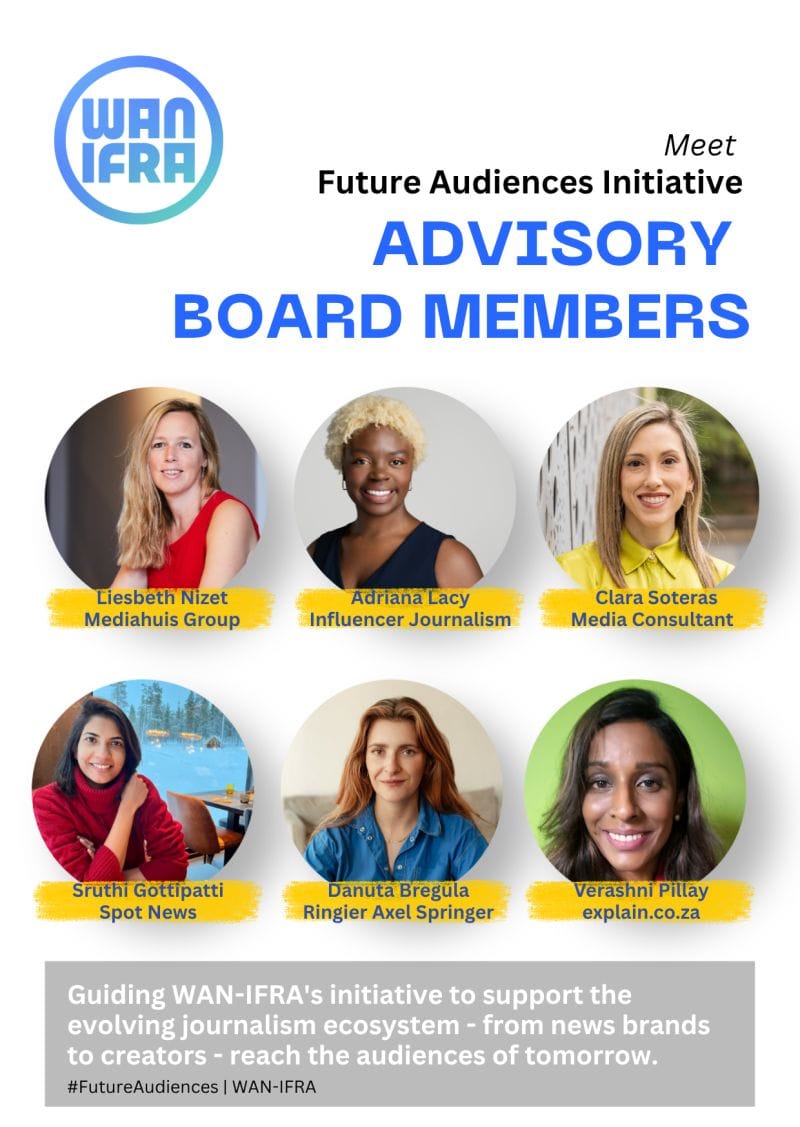
📰 Joining the WAN-IFRA Future Audiences Advisory Board. I'm honored to join WAN-IFRA'sFuture Audiences Initiative advisory board, alongside Liesbeth Nizet (Mediahuis Group), Clara Soteras Acosta, Sruthi Gottipati (Spot On News), Danuta Breguła-Poniatowska (Ringier Axel Springer), and Verashni Pillay (explain.co.za). The board's mandate is exactly the work this newsletter is about: helping news publishers reach the audiences traditional media isn't serving, and making the case for independent, verified journalism in formats those audiences actually use. More on what this work looks like in the coming months.
🎓 Mid-cohort with CatchLight Creator Collaboration: We just wrapped Session 3 of our four-part cohort with five newsrooms — Texas Tribune, Montana Free Press, Enlace Latino NC, The Florida Trib, and Signal Cleveland — working through partnership strategy and agreement drafting.
📞 Taking on clients: If your newsroom is ready to develop creator partnerships, train reporters in platform-native content, or build out vertical video workflows, reply to this email. This is exactly what we do.
👋 Always: If you know someone at a newsroom thinking about creator partnerships, forward this their way.
💡
From the Field Nine Group Family If you haven't seen it yet, Adriana Lacy Consulting just relaunched its publication as Field Notes, focused on audience, trust, and the institutions that communicate with them. The latest piece, "What Demographics Miss: The Case for Situation-Based Audience Strategy," introduces a new framework called TCI (Task, Context, Intent) that argues institutions need to stop describing audiences by who they are and start understanding them by what they're trying to do.
The connection to this newsletter is closer than it might look at first. The whole point of starting with the goal instead of the creator is that specificity beats generic targeting every time, and TCI is the audience-side version of that same idea. If you found this issue's framework useful, the Field Notes piece is worth your time.
Adriana Lacy is the founder and CEO of Field Nine Group, where she leads Influencer Journalism and developed the STEPP Framework for ethical newsroom-creator partnerships. Previously, she worked at The New York Times, LA Times, and Axios.