A 29-year-old YouTuber now matches France’s biggest network in audience trust. TF1 is partnering with him — and creators like him — to lend the newsroom some of that credibility. Early results suggest some of these alliances aren’t working
A newsroom with no dedicated social staff used the cohort to assemble a cross-team working group and plan its first original creator collaboration, a series on the city's beloved sausage culture.
For a nonpartisan newsroom covering politics, the toughest part of a creator partnership came before any outreach: deciding which creators it could work with without putting its credibility at risk.
Welcome to the first issue of Influencer Journalism Weekly. This newsletter exists because the intersection of newsrooms and creators is no longer experimental, it's existential.
For those who don't know me, I'm Adriana Lacy, CEO of Field Nine Group and the founder of Influencer Journalism. I'll be the one in your inbox each week, along with case studies from our writers and insights from our research team. Think of this as your behind-the-scenes pass to how newsrooms and creators are actually making partnerships work, what's failing, and what we're learning along the way.
The data is stark: 21% of U.S. adults now regularly get news from influencers on social media, rising to 38% among adults under 30. Meanwhile, global trust in news remains stuck at 40%. Traditional outlets are losing ground. Creators are gaining it. The question isn't whether journalism and the creator economy will converge as we know they already have. The question is whether that convergence will strengthen journalism's public service mission or dilute it.
That's what this newsletter is about: building the frameworks, sharing the case studies, and tracking the research that helps newsrooms get this right.
Each week, we'll bring you original analysis, curated industry news, partnership case studies, and tactical advice. Let's get into it.
The STEPP Spotlight
When newsrooms partner with content creators, they enter territory without a guide. Editorial standards that have shaped journalism for generations suddenly meet an ecosystem built on authenticity, algorithm optimization, and audience intimacy. The result is often confusion, missed opportunities, or worse, partnerships that compromise the credibility of both parties.
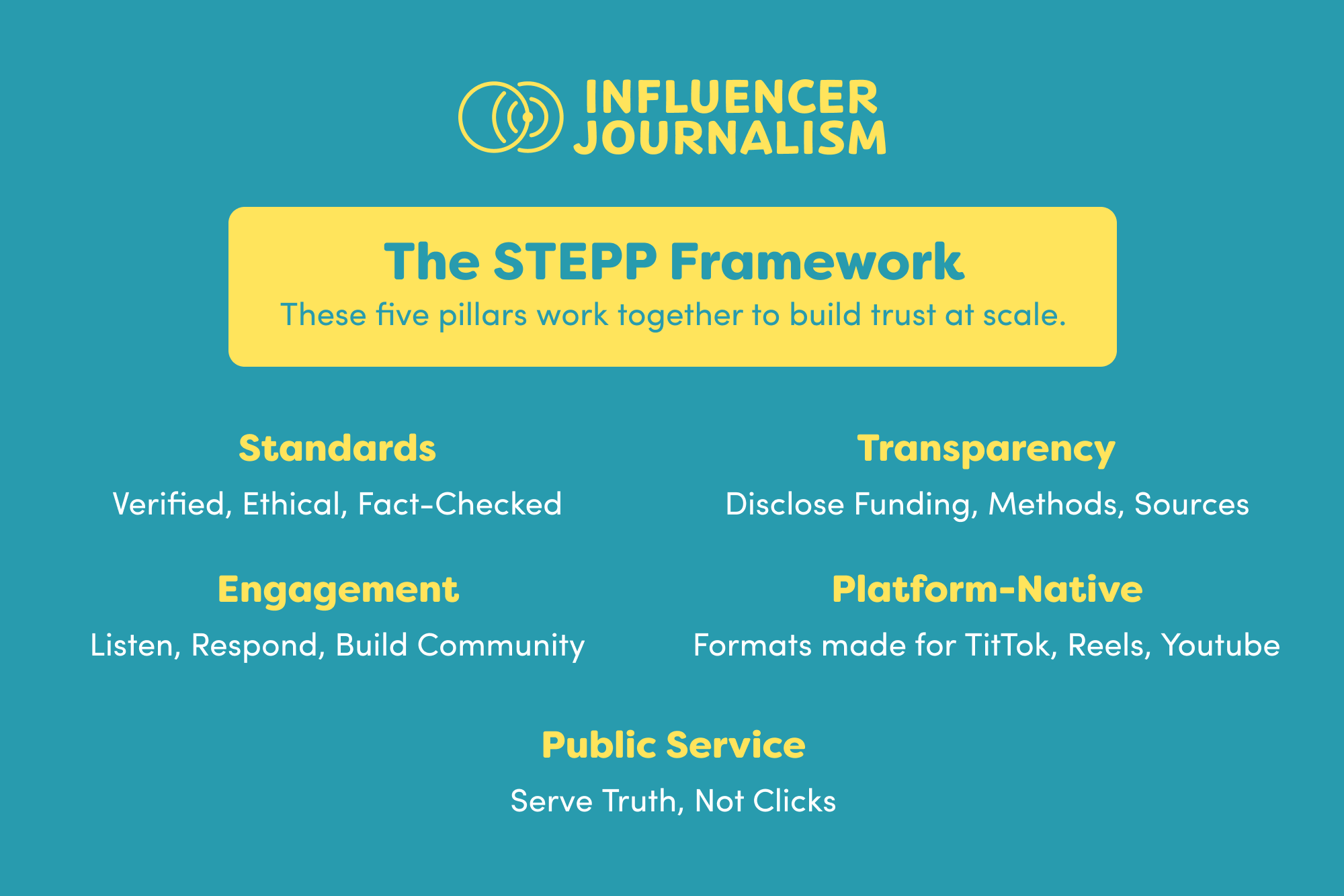
Developed through consulting with newsrooms from nonprofit startups to major metropolitan dailies, STEPP offers five pillars for responsible creator collaboration:
S — Standards: Every factual claim in collaborative content must meet newsroom standards for verification. This doesn't mean creators can't offer opinions but factual assertions require the same rigor applied to traditional journalism.
T — Transparency: Audiences deserve to know when content involves collaboration between newsrooms and creators. This goes beyond FTC requirements to include editorial collaborations, financial relationships, and process transparency.
Sign up for the Influencer Journalism Newsletter
No spam. Unsubscribe anytime.
E — Engagement: The most successful partnerships create ongoing connections, not one-off transactions. Approach creators as partners, not vendors. Invest in understanding their work before discussing specific collaborations.
P — Platform-Native: Content that works on Instagram won't necessarily work on TikTok or YouTube. Respect creator voice and platform expertise. The goal is reaching people with important information, not necessarily converting them to website traffic.
P — Public Service: Every partnership should have a clear answer to the question: How does this serve the public? If the answer is only "it extends our reach," the partnership may be missing its primary purpose.
The newsrooms succeeding in this space are proving that responsible creator partnerships are possible. Their experiments offer concrete models for others to follow.
The Infrastructure Gap That Will Define Journalism's Next Chapter
Rachel Lobdell, executive director of News Creator Corps, wrote for Nieman Lab last month that creator partnerships are "ripe for opportunities, if newsrooms do the work." Her diagnosis is sharp: creators worry newsrooms will use them as distribution channels without genuine collaboration. Newsrooms worry about how it would all work. Both concerns are valid.
The deeper issue, as Liz Kelly Nelson and the team atProject C have been documenting, is infrastructure. Creator journalism is happening with or without proper systems for standards, fair partnerships, and editorial independence. The next 18 months will determine whether the field develops sustainably or tumbles into the exploitative dynamics of the broader influencer economy.
One promising development: Project C'sTop 50 Creator Model Journalists list, released in July 2025, is the first serious attempt to map who's doing this work well. Their finding that 86% of top creator journalists are white and 54% are male suggests significant work remains to diversify the field.
Why it matters for newsrooms: If you're exploring creator partnerships, you're not alone and there's a growing community working through the same questions. The organizations building infrastructure now will shape how the field develops.
Also worth noting:
TheWAN-IFRA News Creator Exchange is connecting digital news creators with traditional newsrooms across Asia, with plans to expand globally in 2026.
The American Press Institute's2025 Influencer Learning Cohort supported 16 newsrooms experimenting with creator partnerships, building on learnings from their 2024 cohort.
The Partnership Watch
When MLK50: Justice Through Journalism in Memphis launched a Creator-in-Residence program with Amber Sherman, a policy organizer and TikTok creator with 45,500 followers, they knew they were navigating uncharted territory.
Sherman is a newsmaker. Her policy work attracts media attention. She has her own platform and voice. These are exactly the complications that make newsrooms hesitant to pursue creator partnerships.
MLK50 planned for them anyway. Our writer Ana Clara Otoni dove into this in our latest case study:
The setup: Sherman produces two civic education videos per week, covering everything from public hearings to how to lobby a legislator. She co-designed the year-long residency with the newsroom, formalizing a contract that included weekly posts, monthly payments, and digital training for MLK50's staff.
The ethical guardrails: When staff raised concerns "Amber is a newsmaker. How do we manage that?" leadership didn't dismiss them. They set clear boundaries: Sherman would focus on civic education, with branding and messaging reinforcing that distinction. They created a landing page clarifying the residency relationship and her independence outside branded content.
The crisis test: A few months into the partnership, Sherman was briefly detained during a police operation. MLK50 maintained close communication and coordinated with reporters on the ground while Sherman's phone was inaccessible. When Sherman was ready, she shared her experience on her own platform, not through MLK50. The newsroom's coverage focused on the incident's implications: Sherman's removal from a local police reform task force.
The results: 665% growth in social interactions. A new hire. Funder attention. And crucially, proof that the model works.
"One of the things people need to understand," says co-executive director Adrienne Johnson Martin, "is that the reason you were attracted to them was because of that other stuff they're doing. So you can't be afraid of that person."
The STEPP takeaway: This is what the Engagement pillar looks like in practice. MLK50 didn't treat Sherman as a distribution channel. They integrated her as a partner with real editorial collaboration, clear boundaries, and mutual value exchange.
Here's the preview: The FTC's 2023 Endorsement Guides clarified that built-in platform tools like Instagram's "Paid Partnership" label may not be sufficient on their own. Disclosures must be "clear and conspicuous" meaning audiences should immediately understand the relationship without scrolling, clicking "more," or decoding hashtags.
For newsrooms, the stakes are higher than legal compliance. When audiences discover undisclosed relationships after the fact, they don't just lose trust in the creator they lose trust in the newsroom that partnered with them.
Your assignment: Pull up the last three creator posts that mentioned your newsroom. Ask yourself:
Is it clear what the relationship is?
Would a first-time viewer understand how the content was produced and verified?
Does the disclosure appear where audiences will immediately see it—not below the fold, not buried in hashtags?
If you're not sure, your audience isn't either. For the full breakdown including specific language recommendations and a disclosure checklist read the complete piece.
📰 Just published:Why Disclosure Matters More Than You Think, a research-backed guide to transparency in creator partnerships, including what rigorous disclosure actually looks like and why cutting corners isn't worth the risk.
🚨 Grant deadline alert: TheLenfest News Creator Collaborative is offering up to $100,000 per organization for newsrooms experimenting with creator partnerships. The focus areas align almost perfectly with what we cover in this newsletter: audience growth, creator co-production, trust and transparency, measurement. Applications are due Monday, January 12 (yes, that's four days from now). If you've been thinking about this work but haven't had budget to experiment, this is worth a look.
📞 This quarter: We're taking on consulting clients internationally for creator partnership strategy, including helping newsrooms design grant proposals and partnership frameworks. If you're scrambling on that Lenfest application or want to build something longer-term, reply to this email.
👋 Always: If you know someone at a newsroom thinking about creator partnerships, forward this their way.
Adriana Lacy is the founder and CEO of Field Nine Group, where she leads Influencer Journalism and developed the STEPP Framework for ethical newsroom-creator partnerships. Previously, she worked at The New York Times, LA Times, and Axios.