
Your Next Creator Partner Might Be a Professor
The latest High Country News collab proves the best creator partnerships aren't where you think
The latest High Country News collab proves the best creator partnerships aren't where you think

375 journalists lost their jobs at The Washington Post. The answer isn't solo vs. institutional but what we build between the two.
New research from FT Strategies and Knight Lab breaks the myth — plus why the "E" in STEPP matters more than ever, and what we're up to at the Saudi Media Forum.
The latest High Country News collab proves the best creator partnerships aren't where you think

You’ve heard the pitch a hundred times: “We need to partner with creators.” But here’s the question nobody asks first: who are the creators in your ecosystem, and what does that landscape actually look like?
Before you can build a single partnership, you need a map. Not a metaphorical one but a real, researched, data-driven overview of the creator ecosystem surrounding your newsroom, your beat, or your region. That’s where influencer mapping comes in, and it’s the most underrated step in the entire creator-newsroom pipeline.
The Reuters Institute’s 2026 Trends report made it crystal clear: 76% of publishers plan to encourage journalists to act more like creators, 50% intend to partner with creators for distribution, and 31% are considering hiring them directly. The intent is there. But the infrastructure? That’s where things fall apart.
Most newsrooms skip straight to the partnership phase without understanding the terrain. They reach out to the biggest name they can find, throw money at a one-off collaboration, and call it a strategy. It’s like launching a marketing campaign without doing market research.
An influencer ecosystem map changes everything. It’s a comprehensive audit of who’s creating content in and around your coverage area across platforms, across beats, across demographics. It tells you who the trusted voices are, where the gaps exist, and where the real opportunities for ethical, sustainable partnerships live.
At Influencer Journalism, our ecosystem reports go far beyond a simple spreadsheet of names and follower counts. Here’s what we deliver:
Creator Identification and Categorization: We identify creators operating in your geographic area and/or beat, cataloging them by platform (Instagram, TikTok, YouTube, Substack, etc.), content focus, audience size, and engagement patterns.
Credibility and Ethics Assessment: Using our proprietary STEPP Framework, we evaluate creators on their transparency, public service orientation, and engagement practices so you know who aligns with journalistic values before you ever reach out.
Landscape Analysis: What topics are oversaturated? Where are the content deserts? Which communities are underserved by both legacy media and creators? This is the strategic intelligence that drives smart partnerships.
Partnership Recommendations: We give you a prioritized roadmap of who to partner with, how, and why, based on your specific goals.
Competitive Context: Understanding what other newsrooms and organizations in your area are already doing in the creator space, so you can differentiate.
We’ve seen this work move the needle. When we partnered with PublicSource in Pittsburgh through the American Press Institute’s Influencers Learning Cohort, we mapped more than 40 Pittsburgh-based creators on Instagram. That mapping work directly led to eight new conversations with creators and sparked the newsroom’s first creator partnership, with more in development.
Mapping isn’t a nice-to-have. It’s the foundation that every successful creator strategy is built on.
Here’s what sets us apart: with our network of 65+ researchers spanning more than 20 countries, we’re positioned to do this work internationally. Whether you’re a newsroom in London, a media development organization in Nairobi, or a foundation funding journalism innovation in São Paulo, we can map the creator landscape in your market. We’ve spoken on this work at conferences from London to Chiang Mai, and our international perspective means we understand the nuances of creator ecosystems across different media cultures.
Interested in an ecosystem report for your market? Let’s talk. Reach out at info@influencerjournalism.com and we’ll set up a conversation about what mapping looks like for your organization.
When newsrooms hear “creator partnership,” most immediately think of news influencers, someone already covering current events on TikTok or running a politics newsletter on Substack. That instinct makes sense, but it’s also the single biggest limitation holding creator strategy back.
Case in point: we recently sourced and connected a creator for High Country News whose partnership just went live and she isn't a news influencer at all. She's a geologist.
Marli Miller (@geologyeverywhere) is a senior instructor and researcher in the Department of Earth Sciences at the University of Oregon. She’s authored multiple books, including Roadside Geology of Oregon and Roadside Geology of Washington. Her website, geologypics.com, offers free downloads of more than 5,000 geology photographs for educational use. And on Instagram, she’s built an audience of over 26,000 followers who come to her for accessible, beautifully photographed geology content from Wyoming’s oldest rock formations to the story of how the Rocky Mountains rose.
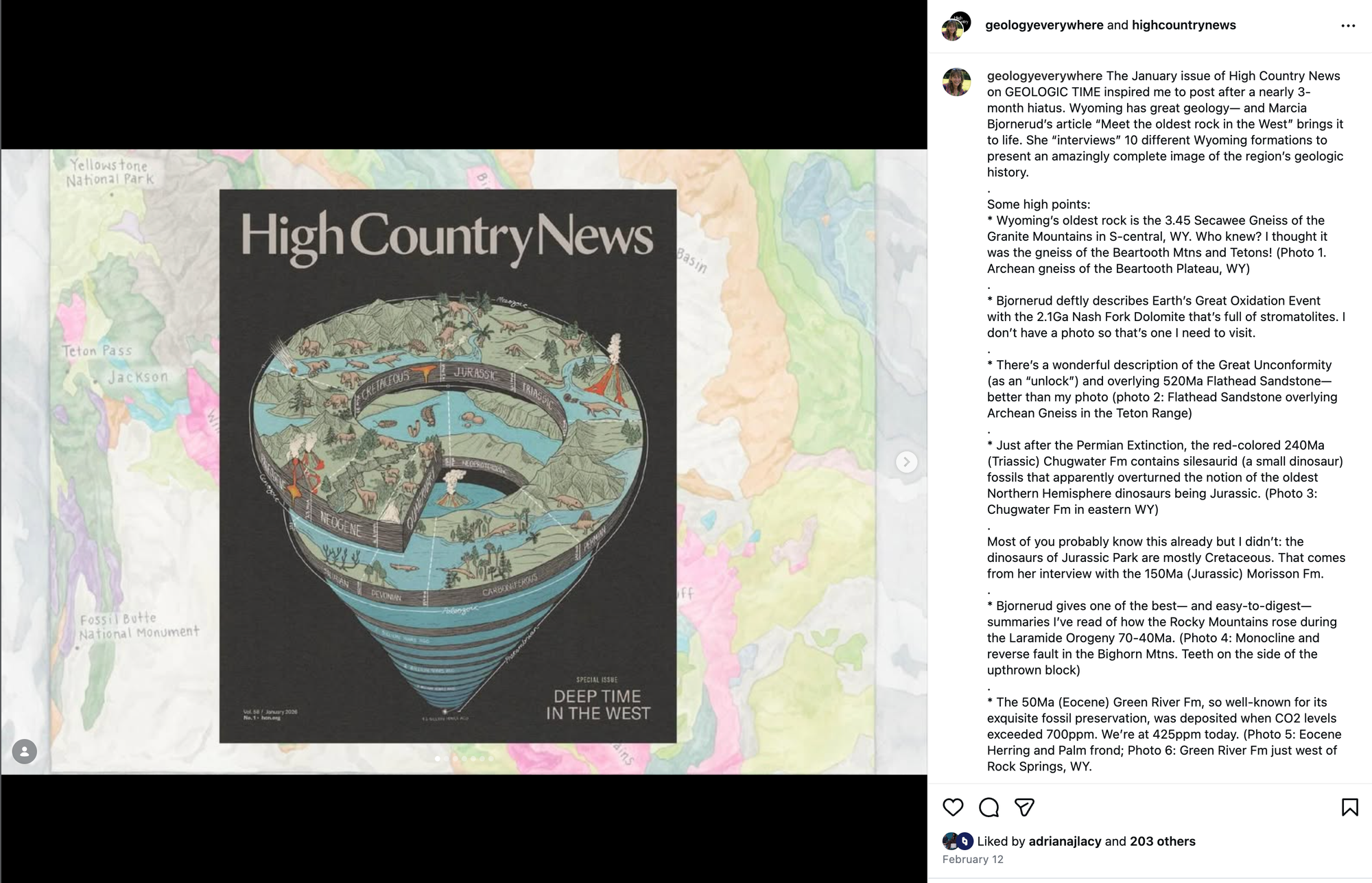
Marli is not a journalist. She’s not a “content creator” in the way most people use that term. She’s a subject matter expert with a genuine, organically built audience who trusts her because of her deep knowledge, her credentials, and decades of field work. That’s exactly what makes her a powerful partner for a newsroom like High Country News, which covers the complexities of the American West.
This is the mindset shift we need the industry to make. The most valuable creator partnerships aren’t always with people who already look and sound like journalists. They’re with professors, researchers, scientists, historians, community leaders, and practitioners, people who have spent years earning trust in their field and who have built audiences that care about substance over spectacle.
Think about it from the audience’s perspective. When someone follows a geology professor on Instagram, they’re opting into a relationship built on expertise and curiosity. That’s an audience that’s already primed for the kind of deep, contextual storytelling that quality journalism provides. That alignment is more valuable and often more authentic than partnering with someone who already has “news” in their bio.
So here’s the challenge we want to put to every newsroom thinking about creator partnerships: look beyond the obvious. Who are the subject matter experts in your coverage area who’ve built real audiences? The marine biologist with a YouTube channel. The urban planner with a popular Substack. The high school teacher whose TikToks about local history go viral. The community health worker whose Instagram reels about nutrition reach thousands of families in your market.
These people aren’t competing with your journalism, they’re complementing it. And an ecosystem map (like the ones we build) is how you find them. The best creator partnerships start with expanding your definition of who a “creator” can be.
🎓 The EdSurge Voices of Change Fellowship has expanded and we helped build the creator track. Now in its fifth cohort (2025–26), the program originally brought together K–12 educators to publish first-person essays at the intersection of identity, teaching, and technology. This year, EdSurge tapped us to design a new creator fellowship alongside it, extending that same model into platform-native formats. If you're thinking about what a 'creator fellowship' could look like for your organization, this is the blueprint.
📺 Reinventing Local TV News: Now Accepting Newsroom Partners: Northeastern University’s Reinventing Local TV News Project, backed by a $3 million Stanton Foundation grant, is seeking newsrooms to host Stanton Innovation Fellows and Co-ops as Digital Content Creators. These roles are focused specifically on engaging younger audiences through social video and platform-native storytelling—exactly the kind of digital-first roles the project’s Survival Guide for Local TV News recommends every station invest in. Newsroom partners contribute half the salary for fellows; co-ops are fully funded. The deadline to apply is April 13. Email reinventingtvnews@gmail.com with questions.
✍️ Journalists Are Coming for the Creator Economy: A timely piece from CreatorFest Collective explores the growing wave of journalists embracing the creator economy.

375 journalists lost their jobs at The Washington Post. The answer isn't solo vs. institutional but what we build between the two.

New research from FT Strategies and Knight Lab breaks the myth — plus why the "E" in STEPP matters more than ever, and what we're up to at the Saudi Media Forum.

For 50 years, High Country News used direct mail to find readers. Then they partnered with a TikTok creator who understands water policy. Here's what happened and what it teaches about platform-native content

The Reuters Institute's 2026 report confirms creators are essential to journalism distribution. Plus: joining WAN-IFRA's News Creator Exchange board, and what it looks like to invest in genuine partnerships